Saturday, 9 January 2016

An Epilogue (For Now)

It is finally time for me to present this documentary: Under The Dome by Chai Jing. I wanted to do so in the introduction, but saved the best for the last. 


Chai Jing, both the director and narrator, worked for China Central Television (CCTV) as an investigative reporter and host. After leaving CCTV, she undertook independent investigation into China’s air pollution problem and produced this self-financed documentary. It was uploaded on February 28, 2015, on the Saturday preceding the annual meeting of the National People’s Congress (NPC), and went viral instantaneously. It was viewed more than 150 million times over the weekend (Reuters, 2015)- as a reference, there were approx. 668 million internet users in China by June 2015 (Sina, 2015) - and stimulated heated debates - for instance, 280 million posts on Weibo, China’s version of Twitter (The Guardian, 2015).

The 104-minute documentary takes the simple form of a TED talk, with Ms. Chai given a presentation, combined with charts, interviews and footages of site visits, to a live audience. Yet its power is astonishing. The documentary is divided into three parts, each of which answers one of the following questions: What is smog? Where does it come from? And what can we do about it? In the second and third part, Chai Jing approached several sensitive topics (with honest comments from many government officials and industry insiders), including China’s urbanisation bubble and its relation to air pollution, the lack of law enforcement of the Ministry of Environmental Protection, and low oil quality standards dictated by the industry itself, and further raised the question of the feasibility of opening up the currently state-owned monopolised petrochemical industry. 

Probably because of these sensitive topics and truthful comments from government officials and industry insiders, the documentary was ordered to be removed a week after. Yet also based on these and the fact that the film was first released on the website of the People’s Daily, the official newspaper of the Chinese Communist Party, alongside an interview with the Minister of Environmental Protection Chen Jining, in which he highly praised it, I personally believe that it could not have been made and released without the support of the government, or at least part of it. The government may intended to use this documentary to signal its determination in combating air pollution prior to the NPC, but did not expect such tremendous reactions. In fear of further simmering of public discussions leading to uncontrollable incidents, they took it down. 

Others may beg to differ. Either way, another, probably more important signal Under The Dome has sent is that the masses are awake. According to a survey by the Pew Research Center (2015), air pollution is the second biggest concern of Chinese people (viewed as “a big problem” by 76% of the respondents), just after corruption (84%). Some may even benefit from corruption - I mean the corrupt officials themselves - but every body breathe in the polluted air. Concerned citizens are on the move: there are brave public figures like Chai Jing who expose the problem to a wider public, but also ordinary people like my parents investing in improving air quality in their own homes and leading greener lifestyles . And as Ms. Chai has appealed, there is certainly going to be more people who exercise their right to know and to supervise the environmental governance. 

A teacher of my undergraduate studies once told me that he was surprised by how much freedom of speech the Chinese is allowed on air pollution, given that this right is generally restricted in China. This has not always been the case. Both citizens and the government have come a long way since the outbreak of the problem in 2012/2013. After I first watched Under the Dome, I thought of Silent Spring by Rachel Carson, which sparkled the environmental movement in the US in the 1960s. In my opinion, what made the book so successful was not just the scientific findings, but the public recognition of those findings. In this sense, this documentary could actually be the Silent Spring of our generation.

At this point, I would like to say some (not strictly) final words on these three months’ blogging experiences. (I know there is a lonely part 1 in the series "Lessons From the Past" waiting for follow-ups, I am still looking for good documentaries; in fact, the experiences of the UK are briefly mentioned in Under the Dome.)

I really enjoyed writing this blog (except on days when I was stuck with my poor writing), and I hope you have enjoyed reading as well. I feel lucky that I was allowed to choose air pollution in China as the theme, a theme that I am interested in and can personally relate to, and I know more about the subject matter now than I first started. Yet still, approaching this vast and complex problem in just 15 posts is rather sketchy, and the more I study into it, the more I realise  how much I do not know. I started off thinking air pollution was a purely scientific problem, then a problem of law enforcement and finally, an economic problem. Both of which I am afraid I still know little about. But then if I were able to solve air pollution by writing this blog, I would not have been here at all :-P Therefore, I have decided to keep maintaining this blog, as I continue following China’s progress on combating air pollution. Maybe someday, I can even be part of it. The posts will appear less frequent and probably shorter as well. I also intend to incorporate more modelling components - so far I have presented the results of several studies based on modelling. I hope to be able to comment more on the modelling approach itself, as I proceed with my studies.

So thank you, my dear readers, for your support so far, do share your opinions on the subject matter and on my blog with me and, until next time!


Tuesday, 5 January 2016

War on Pollution, pt.2: Do We Stand a Chance?

In the previous post of this series, I explained that China has mostly relied on end-of-pipe technologies to address air pollution, such as desulfurisation and denitrification methods promoted in thermal power plants. Nevertheless, the potential of these end-of-pipe technologies is limited, once they have been universally adopted.

The ultimate solution, which deals with the root cause of air pollution, is to move away from fossil fuels and consume renewable energy. 

The first thing is to cap the most consumed, yet the dirtiest fuel type: coal. Also in that post, I mentioned that the Chinese government is planned to decrease the share of coal in primary energy consumption to below 65% by 2017 from around 67% in 2012, as stated in the Action Plan on Prevention and Control of Air Pollution (click here for full text; English version). This is the closest thing to a coal cap and it did not make it to the newly revised Air Pollution Prevention and Control Law, which means that it is not legally binding. Another problem is that this target value is not absolute. Given that the energy consumption is still growing, the actual amount of coal consumed could still be rising as well. 


There was an absolute target value in the Energy Development Strategy Action Plan, published in 2014: The annual coal consumption should peak by 2020 and be kept below 4.2 billion tonnes (Xinhua, 2014). In November 2015, however, the government admitted that China has actually been burning 17% more coal a year, which meant that the 4.2 billion tonnes goal was already reached in 2013 (see the following figure) (The New York Times, 2015). The new data certainly raises the concern that the peak would be higher. 


China stated in its Intended National Determined Contributions prior to COP21 that it will increase the share of natural gas in primary energy consumption to more than 10% (National Development and Reform Commission, 2015). Natural gas undoubtedly belongs to the fossil fuels, but it is less carbon-intensive and also cleaner-burning: The combustion of natural gas produces less SO2 and particulate matter than coal, as well as less NOx than gasoline and diesel (Union of Concerned Scientists, n. d.). It is often believed to be a bridge fuel in the transition to zero-emission fuels (Forbes et al., 2014). 

Regarding the consumption of petroleum, there is no nationwide reduction targets. Several large cities have imposed restrictions on new car purchase through quotas on license plate, some have even announced to restrict private car use when pollution reaches certain levels (South China Morning Post, 2013). Alternative-fuel vehicles have been subsidised by both the central and local governments (EIA, 2014). 

China also intended to further develop non-fossil fuels and increase their share in the primary energy consumption to about 20% in total (National Development and Reform Commission, 2015). Among the renewables, hydropower is by far the most widely exploited. Yet its capacity is restricted, as many rivers have already been heavily dammed and there are increasing concerns about the social and environmental consequences (Ecology Communications Group, 2013). The wind and solar energy market are expected to grow rapidly. China is now the world’s largest manufacturer of both wind turbines and solar photovoltaics.

To sum up, I believe that the current policies are set in the right direction, though they could be more ambitious. However, “it takes more than just weapons to win a war” (Zhang, Liu and Li, 2014, pp. 5334). Successful implementation of such policies requires execution and transparency, but first and foremost, a shift in priorities and perceptions: The cost of tackling air pollution could be huge, but so does the invisible cost of pollution on human health and productivity. Investments in cleaner air are not simply a brake to the economic growth, but could also be its new engine. 

This shift is simply put, but extremely hard to be made. The following video demonstrates the dilemma which many coal-mining regions, but probably also regions with coal-consuming heavy industries are facing: Coal is destroying people’s health and homes, while giving them a living. For me, it is a very emotional piece, as the old man appearing in the beginning and at the end comes from the same region and thus speaks exactly the same dialect as my grandfather, and looks a lot like him too. You cannot expect these ordinary miners to become employees in new industries at once. During a structural transformation, how are they going to make a living? How will the new profits be distributed? And who will bear the burden of rising prices of energy and other resources?


Now that China has officially declared “war” on pollution (said the Premier Li Keqiang in March, 2014), it is such issues that the government should focus on. If not well handled, there may not only be a short-term economic pain, but chronic social instability as well. 


Sunday, 3 January 2016

Lessons From the Past, pt.1: California

Dear all, here is a short documentary on California's battle against air pollution. 

The smog in California in the mid 20th century was mostly comprised of O3. In present-day China, O3 often overtakes particulate matter as the primary pollutant during the summer months, when less coal is burnt. Tropospheric ozone is formed by the reaction of NOx, CO and volatile organic compounds (VOC) with sunlight, all of which are, to a large extent, linked to vehicle exhaust. With the coal cap in energy consumption and the expansion of the  automative market, the significance of O3 is expected to increase. 

California's precious experiences include coordination and cooperation between the state, local authorities ("air districts") and the academia, a strong government for enforcement as well as the involvement of the market mechanism and the public sector.


Saturday, 26 December 2015

War on Pollution, pt.1: A Chronicle of Legislation and Policies

China’s environmental law system first established with the passage of the Environmental Protection Law (for Trial Implementation, 1979). In 1987, the Air Pollution Prevention and Control Law (APPCL) was promulgated. It was then revised twice in 1995 and 2000. The APPCL 2000 focused on regulating SO2 and coarse particles emissions (Feng and Liao, 2015; Zhao, n.d.).

In addition to legislation, prevention and control of air pollution has also been embodied in state development plans developed every five years, a system inherited from the former Soviet Union and a relic of the planned economy era. The plans originally focused on economic development only, yet in recent years, much attention has also been given to social development and environmental protection (The Economist, 2015). The 10th five-year plan (2000-2005) included emissions reduction targets for the first time: 10% reduction of SO2 emissions from the 2000 level by 2005. The target was repeated in the the 11th five-year plan, as it failed during the previous period (Schreifels et al., 2012; cited in Saikawa, 2014). To meet this goal, flue gas desulfurisation was highly promoted in thermal power plants, experiencing a growth from 12% in 2005 to 82% in 2010. As a result, SO2 emissions decreased by 29% despite the 50% increase in coal consumption in the energy sector (Wang et al., 2012). The 12th five-year plan (2011-2015) included, apart from targets on further reduction of SO2 emissions (8% below 2010 levels), targets on NOx emissions reduction (10%) and carbon intensity reduction (17%) for the first time (Saikawa, 2014). Much hope has been placed on similar end-of-pipe technologies such as selective catalytic reduction and selective noncatalytic reduction (both are denitrification methods) (Wang et al., 2012).

It is also during the implementation period of this five-year plan that air pollution has became a major concern among Chinese people. It all started with the widespread of hourly air quality reports by the US Embassy in Beijing on Chinese internet, as the reading of PM2.5 concentrations went “beyond index” (IAQI>500) in November 2010 for the first time since monitoring established in 2008 (The New York Times, 2013).

Mounting public concern fuelled new policies. In 2012, the first standards for PM2.5 concentrations were approved (see a previous post). In the same year, a five-year plan specifically devoted to improving air quality in three key regions and ten city clusters was issued: the 12th Five-year Plan on Air Pollution Prevention and Control in Key Regions (click here for full text; English version). The plan set binding ambient concentration targets for SO2, NO2, PM10 and PM2.5 for the first time as well as more ambitious emissions reduction targets than the national targets. It also introduced concrete measures in detailed projects (Clean Air Alliance China, 2014). 

In 2013 the government further announced the Action Plan on Prevention and Control of Air Pollution (click here for full text; English version) with stricter standards, higher targets and concrete timetables, summarised in the following figure. Key points are:

a) to reduce urban concentrations of PM10 by 10% by 2017 on the 2012 levels nationwide and concentrations of PM2.5 by 25%, 20% and 10% in three key regions Beijing-Tianjin-Hebei, Yangtze River Delta and the Pearl River Delta respectively; 
b) to decrease the share of coal in total energy consumption to below 65% from around 67% in 2012 (Finamore, 2013) and increase the coal washing rate to above 70% by 2017, to prohibit the approval of new coal-fired power plants and to peak and decline coal consumption in three key regions;
c) to provide National Stage V gasoline and diesel and eliminate “yellow-label” vehicles (old, high-emitting vehicles that fall under China I emission standard (gasoline) or China III emission standard (diesel)) by no later than 2017;
d) to complete the backward productivity elimination target required in the “12th Five-Year Plan” one year ahead (by 2014) in iron and steel, cement, electrolytic aluminum, glass etc. 21 key industries and to eliminate another 15 million tons of backward productivity in iron making, 15 million tons in steel making, 100 million tons in cement and 20 million weight cases of glass in 2015.


To provide legal basis for the action plan, the revised APPCL was passed in this August and will enter into force in Jan 1, 2016. Major amendments include the first acknowledgement of the cost of air pollution on public health, a new framework for regional air quality management and coordination (emphasis on the responsibility of local governments) (Cai and Tang, 2015), an alert system on bad weather conditions that worsen smog as well as regulations on emissions from shipping (Liu, 2015).

The post provides an overview of China’s legislative framework and current policies to tackle air pollution. Next time, we will examine these critically and discuss further possible strategies.  


Sunday, 20 December 2015

COP21 Watch, pt.3: A Small Step For a Giant Leap(?)

It has been a week since COP21 ended and I finally have time to finish this serie. For recap, some of the best moments are summarised in this ten-minute video by UNFCCC:


The closing remarks were all emotional and optimistic - a historic agreement to combat climate change and promote sustainable development has been reached by 195 nations (click here for full text). Its main objectives are described in Article 2:

“a) Holding the increase in the global average temperature to well below 2 °C above pre-industrial levels and to pursue efforts to limit the temperature increase to 1.5 °C above pre-industrial levels, recognizing that this would significantly reduce the risks and impacts of climate change;
b) Increasing the ability to adapt to the adverse impacts of climate change and foster climate resilience and low greenhouse gas emissions development, in a manner that does not threaten food production; 
c)Making finance flows consistent with a pathway towards low greenhouse gas emissions and climate- resilient development. “

Moreover, in Article 4, it resolves to “reach global peaking of greenhouse gas emissions as soon as possible” and, after 2050, anthropogenic emissions should be balanced by “removals by sinks”. 

The Paris agreement is the first universal agreement on climate, for its predecessor the Kyoto Protocol, which had been extended to 2020, contains binding emissions reduction targets for industrialised countries (Annex I countries) only. It is also an ambitious agreement, as it aims for limiting global warming to well below 2 °C, or even below 1.5 °C and reaching climate neutrality by the second half of this century. 

The fact that there is an agreement is already a triumph, and it is a collective triumph of the past several COPs. However, it is still too early to celebrate. 

First of all, the Paris agreement is not yet legally binding. It will be if at least 55 countries which together represent 55% of the world’s greenhouse gas emissions ratify it during a one year period starting 22 April, 2016. Even if the agreement becomes legally binding, there are no legally binding emissions reduction targets per se, unlike the Kyoto Protocol, only Intended Nationally Determined Contributions (INDCs). This relates back to COP15 in 2009 in Copenhagen, which failed because of the attempt of imposing legally binding targets were strongly objected by some parties (BBC, 2015). Also there will be no enforcement mechanisms: a country is not enforced to communicate its INDCs by a specific date, nor will it be sanctioned when failed to comply. Furthermore, even if all parties fully implement their current pledges and policies of similar strength were adopted after 2030, we are still far from reaching the below-2 °C target, let alone below-1.5 °C. Climate Action Tracker (2015) predicted a median warming of 2.7 °C (range: 2.2-3.4 °C) by 2100. 
Source: Climate Action Tracker, 2015.


On the good side, the agreement does announce that the first global stocktake of the implementation will take place in 2023 and every five years thereafter (Article 14) and successive plans ought to be more ambitious than the previous one (Article 3).

In a word, the Paris Agreement itself does not solve global warming, but it sets the ground floor for higher ambition. And we, as citizens, should urge politicians to comply their current and future INDCs. Some of my readers have raised the question of whether China will be able to achieve its INDCs. S join me next time, as I will finally study China’s energy policies. 

Tuesday, 15 December 2015

Tracing Back Pollution, pt.3: A Growing Risk

In the first two posts from this serie, we have looked at air pollutants emissions from power plants, industry as well as residential and commercial sources. There is only one sector left in this familiar figure, namely transport:


Whilst SO2 and particulate matter emissions from the transport sector seem minimal (5% or less), it is an important source of NOx and CO, also volatile organic compounds (VOC). The share of vehicle emissions is higher in urban areas, especially in large cities. A study by Guan and Liu (2013) indicated that the transport sector is the largest source of NOx and the second largest source of total air pollution in Beijing (following the energy sector). Beijing has been shutting down and relocating factories since before the Olympics in 2008, yet car ownership is still rising despite restrictions on new license plates. It is expected to exceed 6 million in 2016 (Xinhua, 2012). 
Source: Guan and Liu, 2013.

Overall, car ownership reached 154 million in China in 2014, the second highest in the world next to the US. However, the ownership per capita was still only a fraction of that of the US, with only 113 vehicles per 1000 person (Xinhua, 2014). The world’s largest automative market expanded at a compounded rate of 24% per year between 2005 and 2011 and still has substantial growth potential. McKinsey predicted an average annual growth rate of 8% till 2020 (Huang, Liu and Hein, 2013). Thus, the share of the transport sector in air pollutants emissions is very likely to increase as well.

Large gross vehicle ownership is causing traffic congestions in many cities (see the following figure), which may further worsen air quality. Vehicles burn the most fuel while accelerating to get up to speed (Environmental Leader, 2012), thus constant accelerating and braking exhausts more pollutants. According to Song (2014), PM2.5 concentrations are more than 3 times higher during rush hours than during off-peak hours on Beijing’s West 2nd Ring road.

Another factor that needs to be considered is the emission standards. China’s current nationwide light-duty emission standard China IV is nearly identical to the Euro 4 standard in terms of limit values, which was phased out in Europe in 2009. The new China 5 standard with an implementation date of 1 Jan 2018 is almost equivalent to the Euro 5 standard, which had been replaced by Euro 6 standard last year. The emission standards for heavy-duty vehicles also follows their European precedents, with a delay of 7-8 years (Transport policy, 2015). Lower standards are linked to higher emissions. And the Volkswagen scandal has raised the question of how much should we trust manufacturers’ environmental claims (and also claims on safety?).

In conclusion, though currently less significant than other sectors, given the ongoing expansion of the automotive market and loose emission standards, the transport sector is likely to contribute more to air pollution in the future.


Thursday, 10 December 2015

Tracing Back Pollution, pt.2: Winter Heating and Air Pollution

It’s finally time for the much-delayed Part 2, in which I will continue examining the sources of air pollution. First, let’s review China’s emission inventory by sectors:

Residential and commercial sources are the second largest source of particulate matter, which is usually the primary pollutant (refers to the pollutant with the highest IAQI, not the origin!) in most Chinese cities (see real-time air quality ranking and a previous post) and the most heath-damaging (see another previous post). Therefore, same as in part 1, we will now look at residential energy consumption in China.

Source: Zheng et al., 2014.

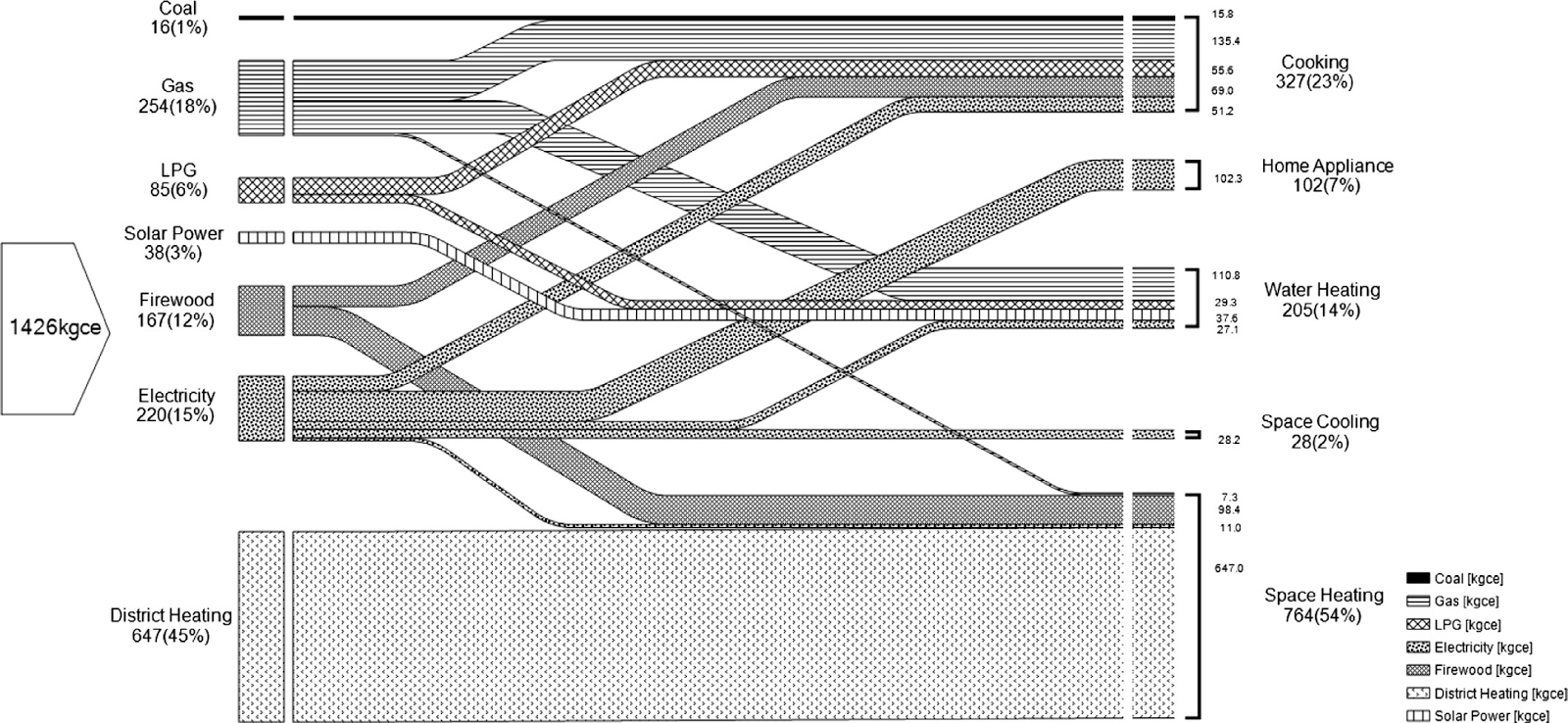
The figure above depicts the energy flow for a typical Chinese household in 2012. This is the outcome of a survey by Zheng et al. (2014), derived from 1450 households in 26 provinces, with 80% from urban areas and 20% from rural areas. According to the chart, district heating is the most important energy source, which supplies 45% of the total energy need. Accordingly, spatial heating is the most energy-intensive end-use, accounting for 54% of the total energy consumption. Spatial heating is mostly fuelled by district heating, but also firewood, electricity and gas.

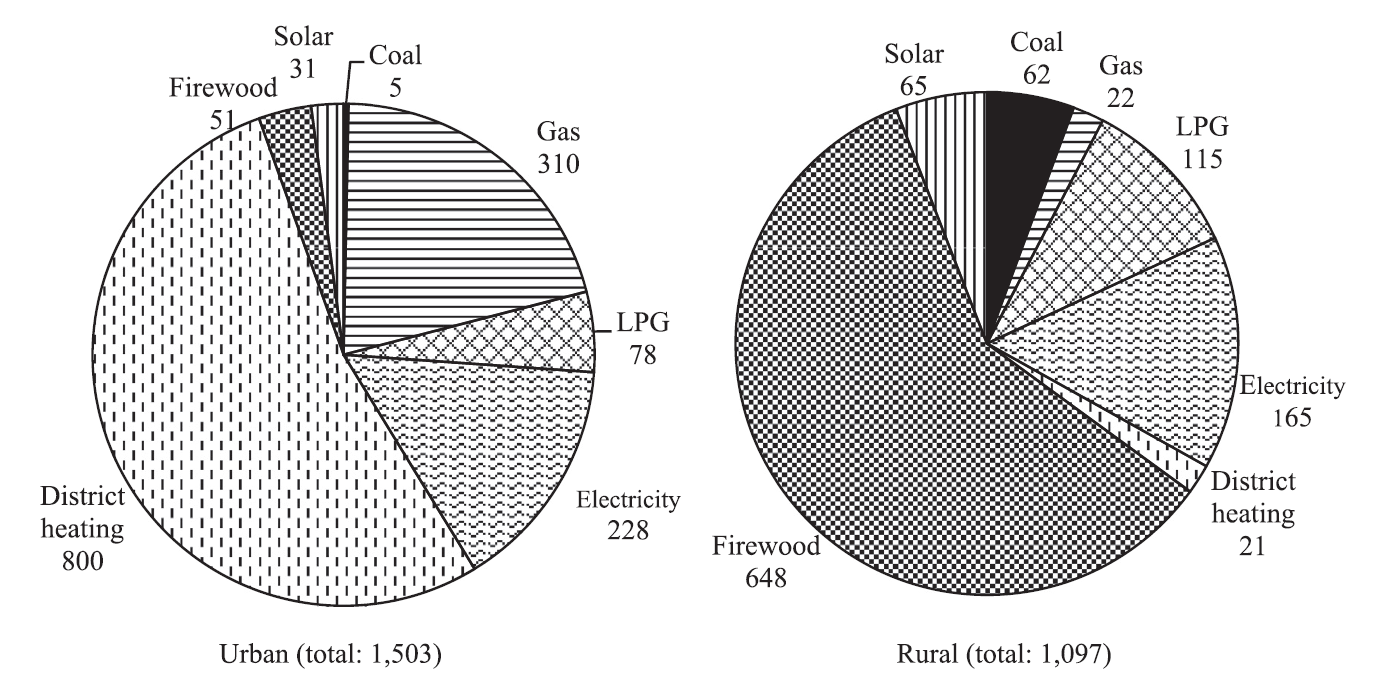
Apart from the small sample size, a major shortcoming of this survey is the small proportion of rural households. In 2012, 48% of the total population in China lived in rural areas (World Bank, n. d.). Hence, rural households are under-represented in the national average. Recognising this fact, Zheng et al. (2014) also examined the energy use of urban and rural households separately:

Source: Zheng et al., 2014.


The two pie charts on the top illustrate energy consumption by energy type, while energy consumption by end-use is shown on the bottom. A main difference is that district heating accounted for 56% of the total energy need in urban households, but only 2% in rural households. By contrast, the proportion of spatial heating in total energy consumption is not significantly different (56% and 40% respectively). 


Winter heating system was established in China between 1950 and 1980. The heating was free during the planned economy period and is still heavily subsidised today. Due to budgetary limitations, it was only entitled to cities north of Huai River/Qinling Mountains (see the following figure), which roughly follows the 0 degree isotherm in January, from November to March. Central heating was (and largely remains) non-existent in southern cities and rural areas until recent years (Almond et al., 2009). Therefore, if Zheng et al. (2014) distinguished between northern and southern China, there would also be a gap in the energy consumption by energy type.
Source: Zhang, Liu and Li, 2014

Based on the abundance of coal compared to oil and natural gas, it is reasonable to assume that China’s heating system relies heavily on coal. Indeed heat is mostly generated by coal-fired heat-only boilers or combined heat and power generators, then sent to households through pipelines. Coal-fired boilers are less efficient than oil, gas or electricity heating systems and substantial energy is lost during transport. Moreover, the incomplete combustion of coal releases several air pollutants, including SO2, NOX and particulate matter (Almond et al., 2009). Almond et al. (2009) studied the relationship between a city’s TSP concentrations and its latitude. In the following figure, each black dot represents a city’s annual mean TSP concentration averaged over 1981 and 1993, while the vertical line represents the Huai River/Qinling Mountains line (33◦N). It is evident that northern cities with winter heating have higher TSP concentrations. More convincing is the discontinuous increase in TSP concentrations at latitudes just above the Huai River/Qinling Mountains line. Because other factors that influence air quality do not vary abruptly around this line, Almond et al. concluded that the heating policy has led to higher pollution levels in northern China.
Source: Almond et al., 2009.


Winter heating is also largely responsible for the seasonal variation in pollution concentrations revealed in a previous post. Xiao et al. (2015) adjusted aerosol optical depth (AOD, a measure of the loss of light due to aerosols on a vertical path through the atmosphere) to reflect ground-level PM2.5 concentrations in China. Their main findings are summarised in this figure:

Source: Xiao et al., 2015.

As shown in the graph, PM2.5 loadings were consistently higher during heating seasons than during non-heating seasons, both in heating areas in the North and non-heating areas in the South. During heating seasons, the mean AOD was about three times higher in heating areas than in non-heating areas. Whereas during non-heating seasons, the average AOD was only slightly higher in heating areas than in non-heating areas. This is due to the different energy structure: Southern China relies more on electricity and oil than northern China, as most coal resources are located in the north and north-west (Xiao et al., 2015).


We've started off at residential and commercial energy consumption, which then led us to central winter heating and, finally back to coal. Residential source is the second biggest source for particulate matter pollution in China. Among residential and commercial energy consumption, heating is a major component. Because of the over-reliance on coal, heating causes significantly higher pollution levels in the winter and especially in northern China.


There have been calls for providing central heating for southern cities, because for cities just south of the Huai River/Qinling Mountains line, for example Nanjing and Shanghai, the winter is just as cold and uncomfortable. If this were to be implemented, coal-fired boilers would certainly not be the optimal choice.